
End-of-life vehicle treatment
A vehicle is made of around two dozen materials, all bolted, glued and pressed together. Our job is to get them apart again.
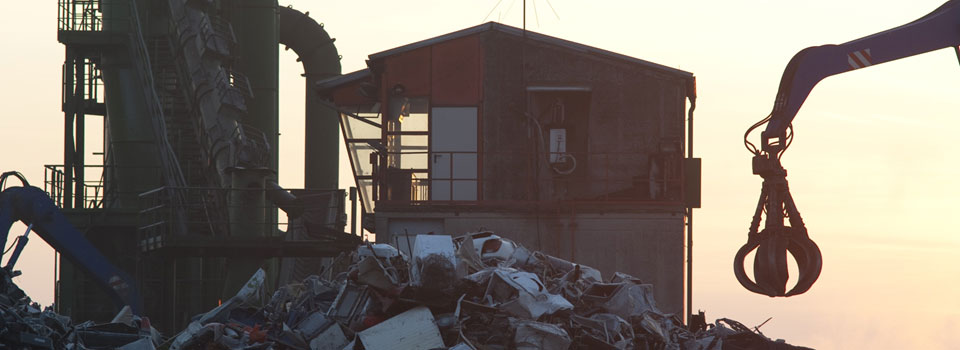
Process
Depollute first, shred second
The order is prescribed by law — and it is also the only sensible one technically.
In the first step all fluids are removed from the vehicle: fuel, oil, antifreeze, brake fluid. Other hazardous or valuable components follow — battery, airbags, catalytic converter. Only once the vehicle is dry does it move on.
In the shredder the body is reduced far enough for iron and non-ferrous metals to be separated. The magnet pulls out the ferrous share — for many operators the process ends there.
For us the real work begins at that point. Downstream processing at MGG Metran additionally separates non-ferrous metals, plastics and mineral matter. Whatever plastic remains goes on to MGG Polymers.
- Depollution under the End-of-Life Vehicles Ordinance
- Certificate of destruction for deregistration
- Shredder for vehicles and mixed metals at the Amstetten site
- Non-ferrous processing at MGG Metran in Kematen an der Ybbs
- Plastics processing at MGG Polymers
Depth of recycling
How an end-of-life vehicle moves through our plants
Four stages, two sites, one material stream. What arrives as a vehicle leaves us as single-grade raw material.
Schematic view of the separation stages. Segment widths show the proportions between fractions, not guaranteed yields.
-
01 — Amstetten
Depollution
Fluids, battery, airbags, catalytic converter and tyres come out before anything is shredded. What is dangerous is removed first.
Hazardous substances captured separately
-
02 — Amstetten
Shredder
The body is broken down to fist-sized pieces. The magnet pulls out the iron — for most operators the process ends here.
Ferrous scrap to the EU-27 grade list
-
03 — Kematen/Ybbs
Non-ferrous separation at Metran
From what the magnet leaves behind we recover aluminium, copper, brass, stainless steel and zinc — fraction by fraction.
Non-ferrous concentrates in trading quality
-
04 — Kematen/Ybbs
Plastics at MGG Polymers
Even the remaining plastics are separated: by polymer type, washed, pelletised and returned into the production of new appliances.
ABS, PS and PP recyclates
Very few operators go this deep. End-of-life vehicles in detail
Data sheet
End-of-life vehicles at a glance
To hand over an end-of-life vehicle you need the vehicle documents and proof that you are entitled to dispose of it.
- Intake point
- Amstetten, Industriestraße 12
- Legal framework
- Austrian End-of-Life Vehicles Ordinance
- Proof
- Certificate of destruction issued
- Please bring
- Vehicle documents, photo ID
- Hazardous parts
- Fluids, battery, airbags, catalytic converter, tyres
- Downstream
- Shredder Amstetten → Metran Kematen → MGG Polymers
Calculator
What your end-of-life vehicles become
Enter the number of vehicles — the calculator spreads the mass across the fractions our separation stages produce.
- Total mass processed —t
- Ferrous scrap —kg
- Aluminium —kg
- Copper —kg
- Stainless steel —kg
- ABS —kg
- PS —kg
- PP —kg
Schematic distribution. Actual yield depends on vehicle type, year and equipment.
Basis of calculation
- Distribution follows the schematic material stream shown on this website.
- Assumed mass per depolluted end-of-life vehicle: 1,100 kg.
- Fluids, battery, airbags, catalytic converter and tyres are removed beforehand and are not included.
The calculator shows proportions, not guaranteed yields. Binding figures come from our purchasing team after inspecting the material.
Larger volumes or a regular supply? Send an enquiry
Tell us what you have.
Whether you are delivering material, buying secondary raw materials or need a disposal route for an entire plant — send us the details. We usually reply the same working day.